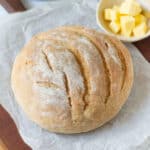
Easy Sourdough Discard Bread
This easy sourdough discard bread has a crackly crust, soft crumb and a gentle tang. It's made with yeast so there is no long fermentation, and you can enjoy a homemade loaf the same day. A delicious, no-waste way to use up your sourdough discard!
Servings: 1 Loaf (10 servings)
Calories: 163kcal
Ingredients
- 1.5 tsp Yeast
- 1 tsp Sugar
- 1 1/4 cups Lukewarm water
- 1.5 cups All Purpose Flour
- 2 cups Whole Wheat Flour
- 1 1/4 tsp Salt
- 1/3 cup Sourdough Discard
Instructions
- In a small bowl, dissolve yeast and sugar in the water. Let stand for 10 minutes until foamy.1.5 tsp Yeast,1 tsp Sugar, 1 1/4 cups Lukewarm water
- In the bowl of a stand mixer, combine both the flours and salt.1.5 cups All Purpose Flour, 2 cups Whole Wheat Flour, 1 1/4 tsp Salt
- Pour in the sourdough discard and the bubbly yeast mixture.1/3 cup Sourdough Discard
- Mix well with a spatula until a rough shaggy dough forms.
- Knead the dough using the dough hook attachment for 8-10 minutes, on medium speed, until the dough is smooth, elastic, and slightly sticky to touch.You can also knead the dough by hand for 10-12 minutes.
- Transfer the dough to a lightly greased bowl. Cover it with a tea towel or cling wrap. Let it rest for 1-1.5 hours, or until the dough is doubled in size.
- When the dough is doubled in size, transfer to a lightly floured surface and gently deflate it. Shape the dough into a ball.
- Place the shaped dough on a parchment-lined tray. Cover it with a tea towel for the 2nd rise. Let it rise for 45 minutes, or until puffy.
- Meanwhile, place a metal tray on the lowest rack and preheat your oven to its highest setting (mine goes up to 250 C/ 480 F).
- Once the bread is puffy, sprinkle the dough top with some flour. Then using a sharp knife, score the bread. Immediately slide it into the oven, carefully pour a cup of water into the tray underneath, and shut the door quickly. Lower the temperature to 220 C/ 430 F and bake for 35-40 minutes, or until the top is golden brown and the bottom sounds hollow when you tap it.
- Cool the bread completely before slicing it.
Video
Notes
- I highly recommend using a kitchen scale to measure ingredients. This ensures consistent and accurate results.
- Your discard doesn’t need to be freshly fed. Use what you have in the refrigerator as long as it doesn’t smell funky or have any mold on it.
- Make sure your yeast is active. To test, mix 1 teaspoon of yeast in half a cup of warm water. If the mixture gets foamy in 10 minutes, the yeast is good to use.
- The dough should be soft and slightly tacky. If it’s too sticky to handle, add extra flour, 1 tablespoon at a time, but don’t add too much or the bread will be dense.
- Don’t rush the proofing time. For the first proof, the dough should double in volume, and for the second proof, it should be puffy. Press your finger into the proofed dough; if the indentation slowly bounces back, your bread is ready to bake.
- Use a really hot oven. Preheat your oven to the maximum. My oven goes upto 250 C / 480 F. A hot oven helps give the bread loaf a good oven spring and a crackly crust.
- Score the loaf just before baking. This gives the bread more room to expand during baking and gives a pretty finish.
Nutrition
Serving: 1 Serving | Calories: 163kcal | Carbohydrates: 34g | Protein: 6g | Fat: 1g | Saturated Fat: 0.1g | Polyunsaturated Fat: 0.4g | Monounsaturated Fat: 0.1g | Sodium: 293mg | Potassium: 113mg | Fiber: 3g | Sugar: 1g | Vitamin A: 3IU | Vitamin C: 0.001mg | Calcium: 12mg | Iron: 2mg